
Cosmic Carousel
Collect mass to create stars and planets, navigate the universe, and witness collisions shaping celestial objects.
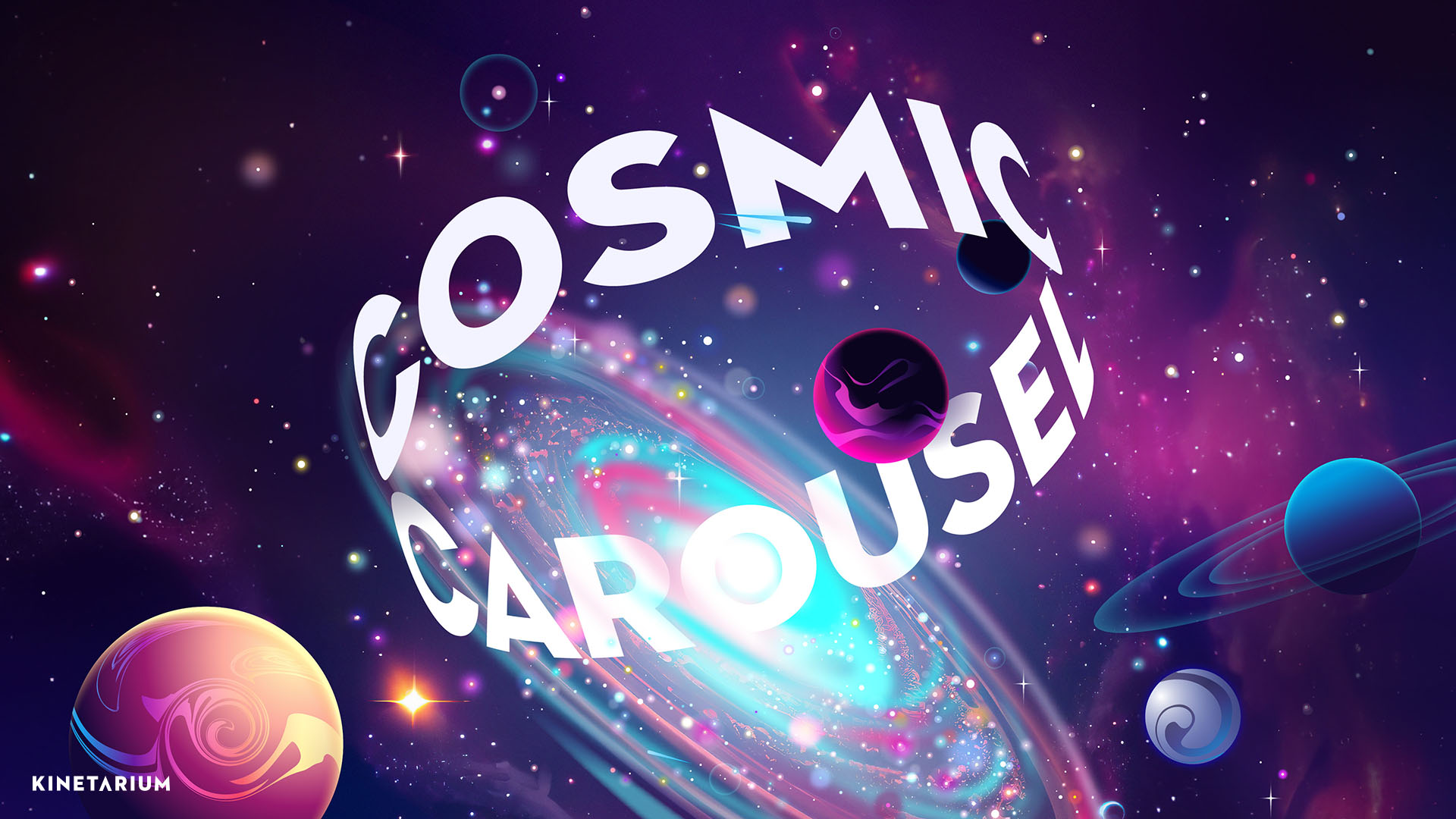
Teaser text
Suns, dust and stars — explore the universe and create your own celestial bodies.
Have you always wanted to be creative and let arise stars? Or understand how it works? Now it's possible: with Cosmic Carousel. Collect as much mass as possible and let celestial bodies grow out of gas and dust.
We'll suspend the laws of physics and leave it up to you to create different stars and black holes.
This interactive science fun playfully conveys what can happen in the vastness of the universe when stars collide, merge or die, white dwarfs grow and pulsars burn up in a supernova explosion.
Detailed description & notes
Floating through the universe and collecting gas and dust clouds: that is the task with the declared goal of creating stars. This eternal cycle is to be experienced interactively.
Each player moves with his controller as an avatar across the universe of the dome. A colored ring around the avatar indicates which class of stars can be created with the mass already collected. This information can also be conveniently viewed via the controller.
In addition to creating stars, it is also possible to create planets with less collected mass. If a player is close enough to a star, the planet he has just created orbits. This phenomenon is visually highlighted by a ring.
On the journey through the universe, collisions between celestial bodies can also occur. If this is the case, the one with less mass is absorbed.
Stars can be created, but only with a limited lifetime. Just before reaching the end of their existence, the percentage value (seen on the star on the dome) reaches 0. When the end is reached, the star swells and ejects a planetary nebula or becomes a supernova. Depending on its original mass, new variable astronomical objects are created in turn. These can become “white dwarfs”, “neutron stars” or “black holes”.
Astronomical Phenomena Explained
Main Sequence Stars
0.1 - 0.3M
Red Star
Temperature: 1000-3600°K
Characteristics: Very long lifespan due to slow fuel burning.
End State: Becomes a White Dwarf. These white dwarfs are extremely dense stellar remnants, primarily composed of carbon and oxygen, cooling slowly over billions of years.
Additional Notes: Red stars are relatively faint compared to larger stars like the Sun, making them difficult to observe, especially over large distances. Despite their low luminosity, red stars are the most common type of star in the universe, making up an estimated 70-80% of all stars in the Milky Way.
0.3 - 0.8M
Orange Star
Temperature: 3600-5100°K
Characteristics: Very long lifespan due to slow fuel burning.
End State: Becomes a White Dwarf.
Additional Notes: An example of an orange star is Alpha Centauri B, located approximately 4.37 light-years away. Orange stars are dimmer than the Sun but brighter than red dwarfs. They have lower magnetic activity than larger stars but can still have starspots.
0.8 - 1.4M
Yellow Star (like our Sun)
Temperature: 5100-6000°K
Characteristics: Lifespan of about 10 billion years.
Current State: The Sun is approximately 4.5 billion years old.
End State: Becomes a White Dwarf.
Additional Notes: Yellow stars can have planetary systems similar to our Solar System, potentially with habitable conditions. They are brighter than red and orange stars, making them more visible. In about 5.5 billion years, our Sun will become a red giant and then a white dwarf.
1.4 - 2.1M
Yellow-White Star
Temperature: 6000-6700°K
Characteristics: Average stellar lifespan, slightly shorter than the Sun's.
End State: Becomes a White Dwarf.
Additional Notes: These stars are hotter and more luminous than the Sun. An example is Procyon A in the constellation Canis Minor, one of the brightest stars in the night sky. Yellow-white stars are stable energy sources during their main sequence but are hotter and brighter than the Sun.
2.1 - 6.0M
Bluish-White Star
Temperature: 7600-10000°K
Characteristics: Burns fuel faster than the Sun, higher temperature but shorter lifespan.
End State: Becomes a White Dwarf.
Additional Notes: These stars are extremely hot, with temperatures far exceeding that of the Sun. When they die, they can explode in a supernova, a phenomenally bright event that can outshine entire galaxies. They emit a lot of ultraviolet light, making them very bright and energetic.
6.0 - 12.0M
Blue-White Star
Temperature: 10000-25000°K
Characteristics: Burns fuel much faster than the Sun, with a very high temperature and shorter lifespan.
End State: Becomes a White Dwarf if mass is below 8.0M, otherwise a Pulsar (Neutron Star).
Additional Notes: An example is Sirius in the constellation Canis Major, the brightest star in the night sky. These stars develop rapidly and die much sooner than cooler stars. They are intensely studied by astronomers to understand stellar evolution and behavior.
12.0M and above
Blue Star
Temperature: 25000°K and above, making them the hottest known objects in the universe.
Characteristics: Very short lifespan due to very rapid fuel burning.
End State: Becomes a Pulsar (Neutron Star) if mass is below 25.0M, or a Black Hole if mass is above 25.0M.
Additional Notes: Blue stars significantly influence galaxy architecture, often found in spiral arms and contributing to star formation and galactic dynamics. They have a strong visual presence and are often featured in artistic and cultural depictions of the universe. Their brightness and beauty have fascinated people for centuries.
Stellar Remnants After Death
White Dwarfs
Characteristics: Very small compared to other stars, dense, similar in size to planets. Stable over long periods, possibly millions or billions of years. They gradually cool down and fade over time.
Precursor Mass: 0.1 - 8.0M
Additional Notes: Have extremely high surface temperatures and are very dense. Their luminosity is low compared to other stars.
Pulsars
Precursor Mass: 8.0 - 25.0M
Characteristics: Rapidly rotating neutron star, the fastest known pulsar rotates 43,000 times per minute. Emits beams of electromagnetic radiation and has extremely strong magnetic fields, millions of times stronger than Earth's. They are incredibly dense.
Additional Notes: Pulsars were discovered in the 1960s when astronomers detected unusual periodic signals from space, which turned out to be the regular pulses of rotating neutron stars.
Black Holes
Precursor Mass: Over 25.0M
Characteristics: Gravity so strong that nothing, not even light, can escape. Reflects no light, hence "black." The Milky Way's black hole (Sagittarius A*) is 4.1 million M. Some black holes could exceed 100 billion M.
Additional Notes: Form when very large stars collapse in on themselves at the end of their life cycle, concentrating all their mass into a tiny point. Despite being fascinating objects, black holes are not a threat to Earth or our Solar System. Even if a black hole were to enter our Solar System, the likelihood of a collision would be extremely low.
Events at the End of a Star's Lifespan
Under 3.0M
Planetary Nebula
Characteristics: Colorful clouds of glowing gas and dust floating in space. Often have beautiful shapes, described as "cosmic artworks" by astronomers. Discovered in the 18th century, hundreds of planetary nebulae have been identified in our galaxy and beyond.
Process: Stellar shell ejected into space. Hot, glowing gas forms colorful nebulae, which gradually cool and darken. A white dwarf remains in the core.
Over 3.0M
Supernova
Characteristics: A brief, extremely bright burst of light. Outer layers of the star are ejected into space. Heavy elements like copper, gold, or uranium are rapidly created. Colorful nebulae form as a result of supernovae.
Outcome: Depending on the initial mass of the star, either neutron stars or black holes remain.
Additional Notes: Supernovae are colossal explosions of stars at the end of their lives, often outshining entire galaxies. There are two types: one occurs when a white dwarf explodes, and the other when a massive star collapses.
Controller
Fact sheet
EDUCATION EXPERIENCE
Languages German, English
Duration variable (approx. 10 – 20 minutes)
Recommended age from 10 onwards
Recommended number of players 1 – 100
Credits
Concept Markus Berger, Michael Scholz
Programming Markus Berger
Graphics Julia Bartusch
3D Benjamin Holas
Project management Andi Reuscher, Michael Scholz, Nadiia Yunatska
Music Jonathan Regler
Sound effects Jonathan Regler
Trailer Jonathan Regler
In cooperation with Stiftung Planetarium Berlin