Element Run
Conquer a chemistry-themed obstacle course using smartphones, blending speed and strategy.
Use the properties of substances like mass, density and volume, while skillfully switching between the elements and together, overcome all obstacles. No previous knowledge of chemistry is necessary, but definitely an advantage! Elements, ready, set, go …

Teaser text
The game of elements takes you to the finishing line. Don’t lose your marbles in the periodic table!
Power on, open trapdoor! Now you almost got through this level, then wham! — and back you go to the start! On this track you have not only to be fast, but also have to use your brains. Who do you have to push so things keep going? Who can you overtake so that you are the first to roll over the finishing line? And who would it be better to warn? — because otherwise you could set off a chemical reaction.
Your greatest allies in this obstacle course are also your nastiest opponents — the chemical elements. Which ones make you heavier, which ones magnetic and which ones flammable? Use the properties of substances like mass, density and volume, while skillfully switching between the elements so together, you overcome all obstacles.
Many marbles, five levels and a lot of old acquaintances from the periodic table await you and your smartphones. No previous knowledge of chemistry is necessary, but definitely an advantage!
Elements, ready, set, go!
Detailed description & notes
This show starts automatically.
There are currently 5 different levels available, each with two pairs of elements and the intro to find into the game. With a single button on the controller, each visitor can switch between these elements (the personal ball).
In the levels are various obstacles, including trapdoors, magnets, fire, water, etc. These can only be overcome if you switch to the right element at the right moment, which then, for example, is not magnetic or does not react with water. In the upper part of the dome helpful hints and background knowledge are displayed.
If enough balls are rolled over the finish line (see counter), the next level is automatically accessed. The level of difficulty increases from level to level. In levels 4, 5 and 6 you have to pay special attention to your fellow players, for example, not to trigger a reaction with them.
The level of difficulty increases from level to level. In levels 4, 5 and 6 you have to pay special attention to your fellow players, for example, not to trigger a reaction with them (collision of Na + Cl → table salt).
In this way, various physical and chemical properties (some of which are rather unknown) can be discovered in a playful manner: for example, argon as a noble gas that is not flammable. If the audience cannot solve a level, there is a drop-down menu in the client interface. It allows you to switch between the levels as you like.
Element Run will soon be expanded with more levels and element pairings.
Level overview
Level | Scenario | Interaction |
|---|---|---|
1 | Intro Elements:
| Trapdoors are activated when the element is too heavy (Fe). Lamps are activated when the element conducts electric current (Fe and Al). |
2 | “Lighter than air?” Elements: | Elements that are lighter than air float (He). Elements that are magnetizable react to the magnets (Fe). |
3 | “Fire & Water” Elements: | Flammable elements cannot overcome fire (C). Elements with a higher density than water will descend (C). The noble gas argon (Ar) has a lower density than water but a higher density than air. |
4 | “Let there be light” Elements: | Trapdoors and lamps are activated when the element conducts electricity (Cu). Here the players have to pay attention to the balls of other players rolling ahead. If a trap door is closed in front of you, you should be careful not to activate it and thus open it. |
5 | “Massiv” Elements:
| Trapdoors are activated when the element is too heavy (Pb). The elements can bump into each other to overcome obstacles. Tip: a light element (Al) can be bumped to move further by several heavy ones (Pb). |
6 | “Table salt” Elements: | Water is an obstacle for elements that react with it (Na). In addition, it must be considered by players that Na and Cl cause a reaction when they collide. |
Controller
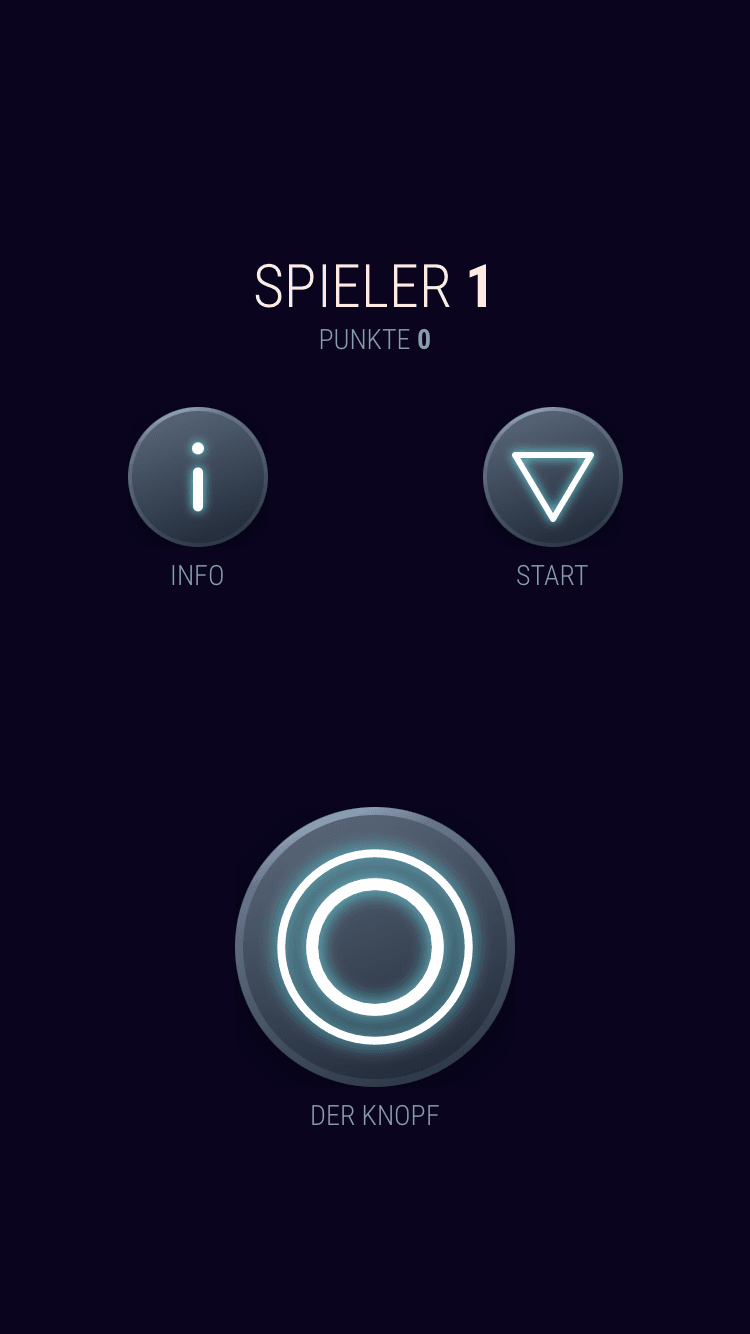
Player number – The respective ball with this number on the dome.
Player color – The color in which the lettering is displayed corresponds to the currently played element.
INFO – Displays the info about the control again.
START – Returns one’s ball to the starting point.
THE BUTTON – The own ball changes to another element (depending on the level) as long as the button is pressed.
Fact sheet
EDUCATION GAME LEVELS
Languages German, English
Duration variable
Recommended age 10 onwards
Recommended number of players 3 – 30
Credits
Concept Julia Bartusch, Sebastian André, Michael Scholz
Programming Sebastian André
Level design Julia Bartusch, Sebastian André
Graphics Julia Bartusch
Project management Judith Gieringer
Text Julia Bartusch
Sound design & music production Daniel Strohhäcker
Music Richard Strauss, Capsun ProAudio, Alex Lustig, Mintz
Trailer Jonathan Regler
Special thanks to Prof. Dr. Uwe Klein